Over the past year, more and more customers have chosen hub motor kits as their favorite way to turn bikes into e-bikes. At Varstrom, our hub motor sales have grown by over 100% year-over-year, and we have received many questions from customers. Because of this, Varstrom wrote this guide to explain how to choose the right kit. We want to help you understand the basics so you can spend your money wisely.

Determine Your Riding Style
Select the appropriate motor performance based on your specific needs. The core parameters to focus on are voltage, power (Watts), torque (N.m), and top speed.
- Leisure and Commuting: For flat city roads, a 250W to 500W motor is usually sufficient. These motors have lower energy consumption, offering longer range and reducing charging frequency. The BAFANG 48V 500W Rear Hub Motor Kit is an excellent choice for this.
- Mountain Climbing: If you need to tackle steep inclines or require quick starts, you need higher voltage and torque. It is generally recommended to choose a motor with at least 65N.m of torque. Note that high power does not always mean high torque; the BAFANG 48V 750W Rear Hub Motor Kit reaches 80N.m, allowing you to conquer hills easily.
- High-Speed Racing: If you frequently ride on flat ground but want maximum speed, focus on Power and Top Speed. Higher power provides higher top speeds. Consider the Varstrom 48V 1000W Rear Hub Motor Conversion Kit, which can reach speeds up to 55km/h.
Battery Capacity and Range
The battery's capacity determines your range, while the voltage determines compatibility with the motor.
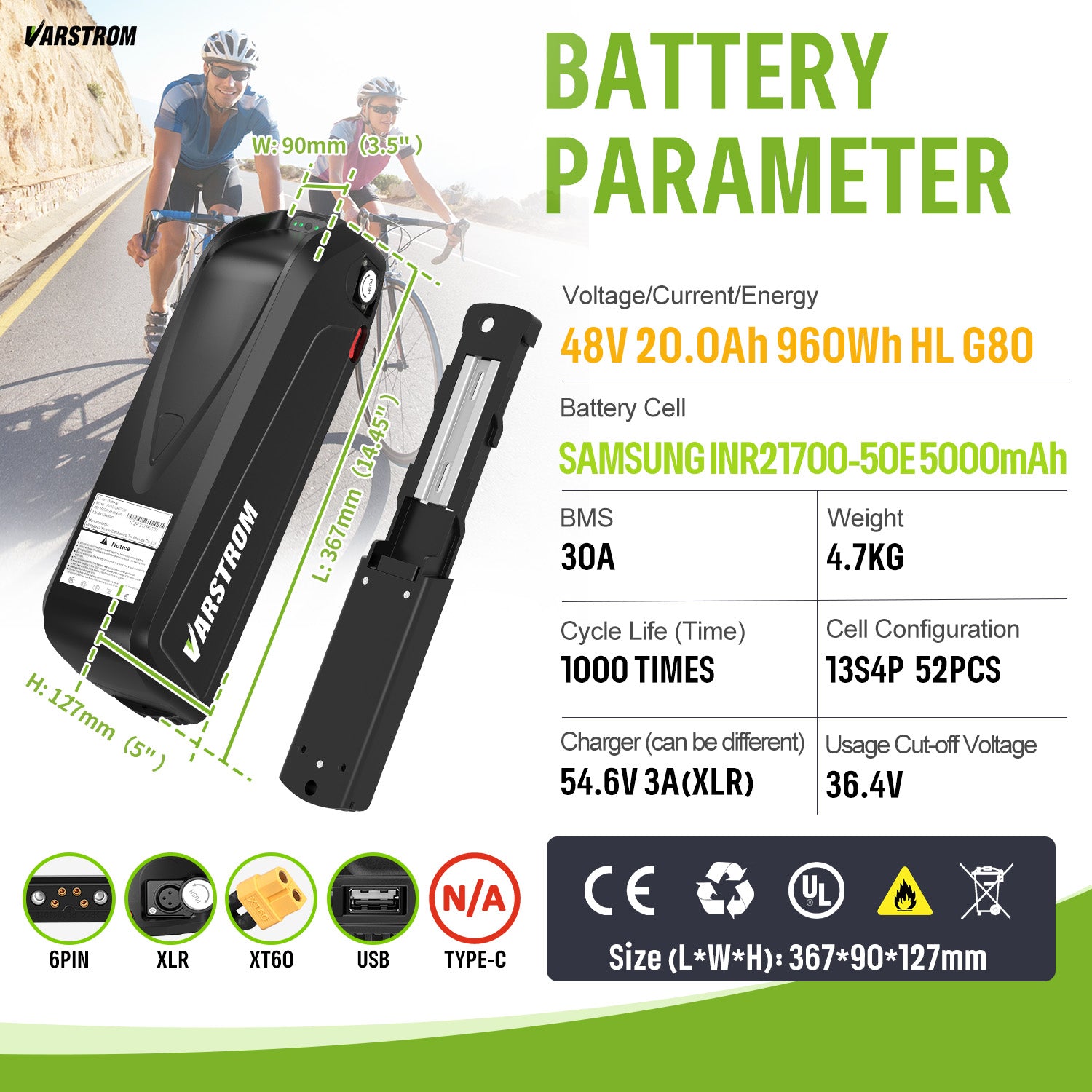
- Voltage Consistency: It is critical that the battery voltage matches the motor and controller. If you choose a 48V motor, you must use a 48V battery and a 48V controller to avoid damaging the system.
- Range Estimation Formulas: You can estimate your range based on battery capacity and motor parameters
- Throttle Mode: Battery Voltage * Battery Capacity / Motor Power * Minimum of Maximum Speed (km/h)
- Pedal-Assist Mode: 2 * Battery Voltage * Battery Capacity / Motor Power * Minimum of Maximum Speed (km/h)

Installation Essentials (Frame Compatibility)
Choosing a hub motor is often the preferred choice for many DIY enthusiasts because the conversion process is relatively easy compared to other systems. Since the motor is integrated directly into the wheel, you don't need to modify your bike's bottom bracket or crankset. However, ensuring "plug-and-play" success depends on matching the kit to your bike's frame specifications.
- Fork/Dropout Opening: Measure the spacing of the front and rear forks of the frame before purchasing.
- The standard front hub motor has an O.L.D. (Over Locknut Dimension) of 100±1mm, so the front fork dropout spacing of the frame needs to be 100 mm.
- The standard rear hub motor usually has an O.L.D. of 142±1mm, requiring a rear dropout spacing of 135 to 142 mm.
- Fat tire bicycles may require wider spacing, such as 175 mm or 190 mm.
- Brake Type: Check if your bike uses V-brakes or disc brakes. If you have a disc brake frame, you can use either disc or V-brake rims, but V-brake bikes must use rims that support V-brakes.
- Tire Size: Check the specifications on your tire's sidewall. Varstrom hub motors support tire widths from 1.5 to 2.4 inches and wheel sizes of 26", 27.5", and 700C.
- Axle Type: Hub motors for Quick Release (QR) frames and Thru-Axle frames are not compatible. Ensure you purchase the version that matches your frame.
- Freewheel/Cassette Type: Screw-on freewheels and Cassettes are incompatible. You must identify your type before buying.Varstrom rear hub motor kits are typically compatible with 10-speed or lower.
- Battery Dimensions: Measure your frame to ensure there is enough space to mount the battery's length, width, and height.
Accessory Selection
- Controller Max Current: The battery’s maximum continuous discharge current must be greater than or equal to the controller’s maximum current.

- Communication Protocols: The display and controller must use the same protocol. Varstrom offers TONGSHENG CAN-BUS and BAFANG UART systems; the display must match the controller type.
- Brake Levers vs. Brake Sensors: If you don't want to (or cannot, such as with hydraulic brakes) remove your original brake levers, choose Brake Sensors. These act as an "add-on" to convert your original levers into electronic brake levers.

- PAS (Pedal Assist Sensor): Check your bottom bracket type. For standard Square Taper axles, Varstrom provides a left-side integrated PAS by default. For other types, or if the distance between the bottom bracket and crank is less than 0.8–1cm, you may need a right-side large-hole PAS.
Summary
If you don't want to spend too much effort learning how to configure the components, you can choose a hub motor conversion kit from Varstrom. Every component in the kit is compatible, so you don't have to worry about incompatibility issues due to protocols, voltage, etc.
Start choosing your hub motor conversion kit today! If you have further questions, feel free to consult Varstrom or leave a comment below.
FAQ
What is an e-bike conversion kit?
A collection of components (motor, controller, display, battery, and sensors) used to turn a regular bike into an electric or pedal-assist bike.
What types of electric bicycle conversion kits are available?
Conversion Kits are divided into Mid-drive and Hub motor kits. Hub motors are further categorized by position (front or rear) and structure (geared or gearless/direct drive).
What is O.L.D?
It stands for Over Locknut Dimension, the distance between the outer faces of the two locknuts on the hub.
Hub motor vs Mid-drive motor?
Choose Hub Motors for low-maintenance city commuting; choose Mid-drive for mountain climbing and off-roading.
Front hub motor vs a Rear hub motor?
Choose Front Drive for flat-road commuting on a budget; choose Rear Drive for better climbing, cargo hauling, and braking performance.
Geared vs Gearless Hub Motor?
Choose Geared for lightweight city riding and light climbing; choose Gearless (Direct Drive) for high-speed cruising and lower maintenance costs.